Chapter 8: Derivative Applications
1. Given the point  , which point on
  is the closest to it?
2. Given  determine all values that satisfy the MVT on the interval
 ![[-3, 5];](images/Maple 19 SVDiff Calc Document Solutions_1076.gif) .
.
3. Given  determine all values that satisfy the MVT on the interval from point
  to point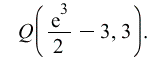
4. A conveyor belt is dumping corn into a large empty silo, forming a circular based cone shaped - heap on the floor. The base radius is twice the size of the height of the pile. If the corn is filling in the space at a rate of 2  / minute, find the rate at which the height is changing when the height is 3 m deep.
5. Housing developers hoping to attract buyers will often build in amenities for community members to enjoy. In a particular community, fishing is a key attraction, so the housing developers agree to build a small lake and stock it with trout. The population of trout over time can be modeled by 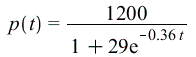 , where time is measured in months.
6. Solve  using Newton's Method.